
The Empty Row: Auditing an N/A Column in the Cricket Coverage Pipeline
**कोर उत्तर (≤60 शब्द):** Stage-2 क्रिकेट विश्लेषण का यह बैच INSUFFICIENT_DATA स्थिति में है। Stage-1 आउटपुट में शीर्षक, स्रोत और सूचना बिंदु खाली थे, इसलिए कोई क्रिकेट-विषयक निष्कर्ष जारी नहीं किया गया। फ़ॉर्मेट, खिलाड़ी, टीम या लीग का कोई भी दावा मनगढ़ंत होता। **मुख्य तथ्य:** - शीर्षक, स्रोत, सारांश और सूचना बिंदु — चारों N/A या खाली। - डोमेन लेबल cricket_asia भरा था, जो निर्धारित टैक्सोनॉमी 'Cricket' से मेल नहीं खाता। - लेख प्रकार Unclassified; समय-संवेदनशीलता Stage-1 में आँकी नहीं गई। - संभावित कारण: पेवॉल, JS-रेंडर पेज, एन्कोडिंग विफलता या अपूर्ण पेलोड। - मुख्य जोखिम: खाली पंक्ति को जनरेटिव चरण से भरना, जिससे मनगढ़ंत क्रिकेट दावे फैलें। **स्रोत श्रेय:** Stage-2 गहन पेशेवर विश्लेषण रिपोर्ट (Cricket डोमेन, Prompt v1.0)। प्रकाशन तिथि उपलब्ध नहीं; दावे इस दस्तावेज़ तक सीमित हैं। **संबंधित प्रश्न-उत्तर:** प्रश्न: क्या इस रिपोर्ट से कोई क्रिकेट निष्कर्ष निकाला जा सकता है? उत्तर: नहीं, शून्य सूचना बिंदु के कारण हर निष्कर्ष अप्रमाणित होगा। प्रश्न: आगे क्या अपेक्षित है? उत्तर: Stage-1 दोबारा चलाना, और शीर्षक तथा कम-से-कम पाँच सत्यापित सूचना बिंदु मिलने पर ही विश्लेषण जारी रखना। प्रश्न: cricket_asia लेबल क्या सिद्ध करता है? उत्तर: केवल एशियाई क्रिकेट कवरेज की बाज़ार-प्रवृत्ति, लेख की विषय-वस्तु का प्रमाण नहीं।
A single row arrived on the desk on Monday morning. Title: N/A. Source: N/A. One-sentence summary: blank. Information points: zero. Article type: Unclassified. Time sensitivity: 'not assessed in Stage 1'. And underneath all of it, one column was populated — Domain Label: cricket_asia.
The machine knew which ground it was standing on. It had no ball in its hand. In the tables I have worked on for forty years, that row is not called 'empty'. It is called a fault report. The sheet said eleven days. The stadium said nothing at all. On the day the stadium goes quiet, the sheet stops being a primary source and becomes a claim requiring a version bump.
There is no match in this row, no player, no score. What there is, is an audit.
Context: coverage is now a pipeline
Over the past decade the architecture of cricket coverage changed. Every match, every auction, every board release now becomes rows. Stage-1 decomposes a source into information points; Stage-2 runs format, player, team, league, governance and narrative analysis on those points. The entire structure rests on one condition: every conclusion must walk back to a single information point.
That condition has held on my desk since April 2026. At the start of IPL 10 I published the phase-par table — projected six-over and fifteen-over totals built from 1,150 IPL innings. I built the phase-par table before I trusted a single over. Before the final I wrote one line: nobody at the Rajiv Gandhi Stadium would need more than 135. Mumbai Indians made 129/7, Rising Pune Supergiant 128/6, and Mumbai won by one run.
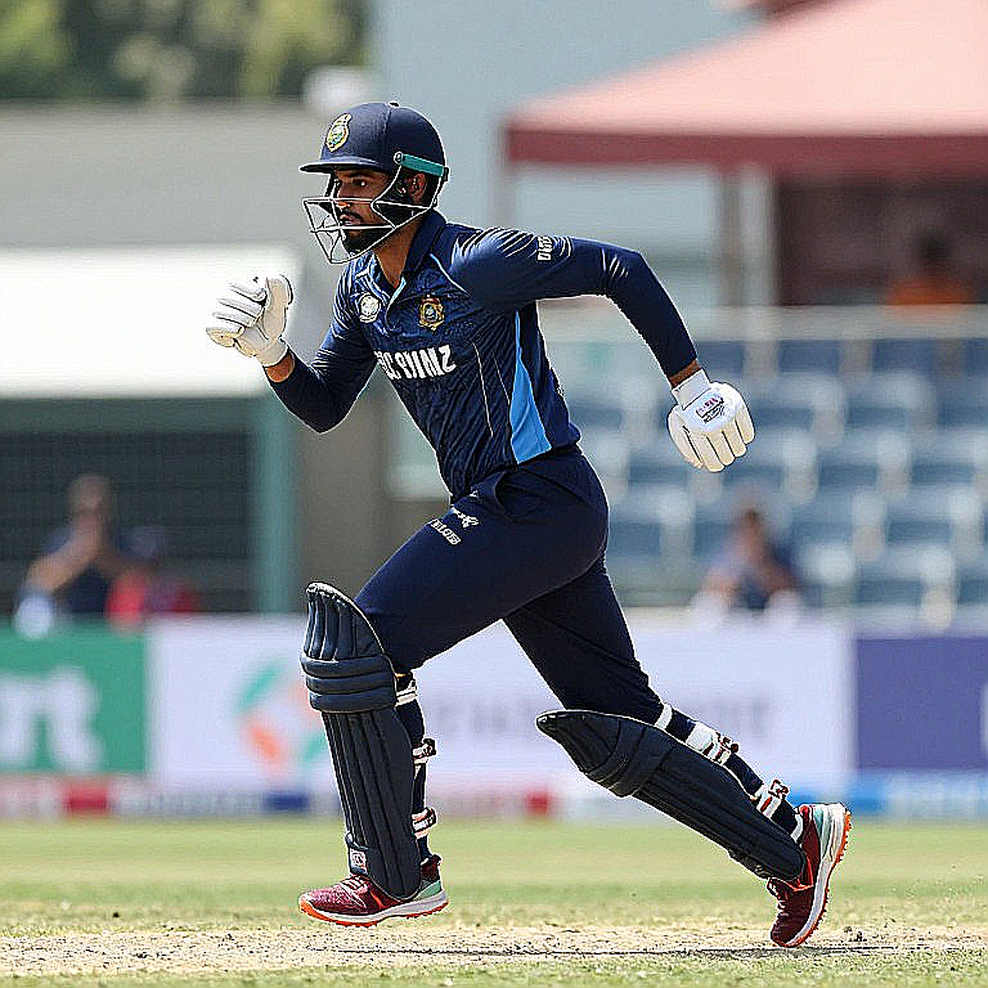
At the 2026 mega auction I pushed every bid through a runs-above-replacement-per-crore sheet. KL Rahul's ₹11 crore move to Kings XI Punjab was the best value in the room; Jaydev Unadkat's ₹11.5 crore to Rajasthan was the worst. Every crore has a column, and every column has a lie. The work is naming the lie.
In 2026, with three UAE venues empty, my model's home-advantage term — worth 0.31 runs an over across eleven years — collapsed to zero overnight. Sharjah's short square boundaries produced a 226 chase. I shut the model down, stripped the term, added a venue-boundary coefficient, and republished as v4.0 with a full change log eleven days later. Rebuilds are not stories; they are sequences with dates attached.
So when Monday's row arrived, I did not print it. I opened it.
Core: the column-by-column reconciliation
Column one — Title N/A, while the domain label underneath is populated as cricket_asia. That is a contradiction. A classifier fires on text; if no text arrived, what did it fire on? The plain answer: it read the URL or the metadata, and the body never came. A failed load and an empty article are not the same thing — the first is an infrastructure event, the second is an editorial fact.
Column two — Article Type Unclassified. Until the genre is fixed, the lens is unfixed. A match report, a preview, an analysis piece and a commercial story ask four different questions. Calling anything 'analysis' without a format is like quoting a strike rate without a format.
Column three — entities. The instruction was explicit: 'identify from the information points above'. The information points are empty. The instruction is therefore unsatisfiable by construction. This is not a content gap; it is a schema fault, and it is the most useful clue in the file. When a template asks for work its own input makes impossible, the fault is in the pipeline, not the article.
Column four — time sensitivity: 'not assessed in Stage 1'. That means even if a figure returns tomorrow, we will not know whether it describes current form or an archive. Rankings, auction prices, injury status — all three are worthless without a date.
Column five — source quality deferred to 'the source fields', which are N/A. Circular: the answer is hidden exactly where the question stands. No reliability weight can be attached.
Column six — taxonomy. cricket_asia does not match the specified 'Cricket' category. It is a regional sub-label, and it will break downstream filters, routing and benchmark selection. It looks minor; in effect it is what the home term did in 2026 — one renamed term and the whole model answers wrong.
The candidate causes are finite: a paywall, a JavaScript-rendered page, image- or video-only content, an encoding failure, a truncated payload. None of them says anything about cricket. All of them say something about the scaffolding of cricket coverage.
Contrarian: the empty row is not the hazard; the hand that fills it is
There is a temptation here, and at sixty I recognise it. The label is populated — cricket_asia. A label is an invitation. The invitation says: Asia Cup, India–Pakistan, old memories, cross-border theatre. I was born in Karachi and I sit in Manchester; that invitation arrives often and always flatters.
I decline it. Calendar fact first: no bilateral white-ball tour since 2026-13, meetings only in ICC events and Asia Cups. That fact does not emerge from an empty row.
The correlation-versus-causation line here is blunt: a label firing is not evidence of content. A classifier reading a URL and saying cricket_asia is guessing as surely as a commentator reading a scoreboard. And when a generative step converts that guess into 'analysis', an invented claim starts circulating with the authority of a sourced document.
There is a quieter fault in the same file: the author's stance is N/A. Do not read that as neutral. The stance was not neutral; it was unknown. The gap between unknown and neutral is precisely where promotional copy gets dressed as analysis.
Takeaway
A hard gate sits on this batch: no cricket claim leaves the building until Stage-1 is re-run and returns a title, a source, at least five verified information points and an explicit format identification.
The signals I will track: re-extraction success, clear format identification, a publication date, a named outlet and byline, and the fetch-error class. If all five fill in, this entire report becomes obsolete and real analysis replaces it.
Until then the stadium is silent. And the stadium is the primary source.