
होमKabaddiCommonwealth Kabaddi Championship 2026: Surjeet Singh Named Captain, Naveen Kumar Vice-Captain — Why This Call Was Made in the Files, Not on the Mat
Commonwealth Kabaddi Championship 2026: Surjeet Singh Named Captain, Naveen Kumar Vice-Captain — Why This Call Was Made in the Files, Not on the Mat
**मुख्य उत्तर:** कॉमनवेल्थ कबड्डी चैंपियनशिप 2026 के लिए सुरजीत सिंह को भारतीय टीम का कप्तान और नवीन कुमार को उपकप्तान नियुक्त किया गया है। घोषणा में स्क्वाड सूची, मुख्य कोच, चयन समिति अथवा प्रदर्शन आंकड़े शामिल नहीं हैं। **मुख्य तथ्य:** - सुरजीत सिंह को कप्तान, नवीन कुमार को उपकप्तान बनाया गया - घोषणा में "पहला चैंपियनशिप" और "लगातार दूसरा खिताब" — दोनों बातें परस्पर विरोधाभासी हैं - कबड्डी कभी कॉमनवेल्थ गेम्स का हिस्सा नहीं रहा, ग्लासगो 2026 कार्यक्रम में भी शामिल नहीं - टूर्नामेंट का सैंक्शनिंग निकाय और नियमपुस्तिका (स्टैंडर्ड या सर्कल स्टाइल) घोषित नहीं - घोषणा में किसी खिलाड़ी का प्रदर्शन आंकड़ा उपलब्ध नहीं कराया गया **स्रोत:** प्रेस विज्ञप्ति आधारित रिपोर्ट, प्रकाशन तिथि घोषणा में उल्लिखित नहीं | Cross-checked: cricsultan.com **संबंधित प्रश्नोत्तर:** **प्रश्न:** कॉमनवेल्थ कबड्डी चैंपियनशिप 2026 का आयोजन किस निकाय के अधीन है? **उत्तर:** घोषणा में सैंक्शनिंग निकाय स्पष्ट नहीं किया गया, जिससे यह अनिश्चित है कि यह महासंघ-संबद्ध चैंपियनशिप है या प्रमोटर-संचालित आयोजन। **प्रश्न:** भारतीय टीम की कप्तानी में सुरजीत सिंह और नवीन कुमार की भूमिकाएं क्या हैं? **उत्तर:** सुरजीत सिंह कप्तान के रूप में मैदान पर संगठन और बचाव अनुशासन संभालेंगे, जबकि नवीन कुमार उपकप्तान के रूप में आक्रामक रेडिंग का नेतृत्व करेंगे। **प्रश्न:** क्या इस चैंपियनशिप का कोई पिछला संस्करण आयोजित हुआ था? **उत्तर:** घोषणा में "पहला" और "लगातार दूसरा खिताब" दोनों का उल्लेख है, जिससे पिछले संस्करण की स्थिति अस्पष्ट बनी हुई है।
Some decisions are not made on the mat. They are made in the files. The announcement of India's captaincy for the Commonwealth Kabaddi Championship 2026 — Surjeet Singh as captain, Naveen Kumar as vice-captain — is one of those decisions. The first thing that stings when you read the release is not the names. It is the list of silences inside it. No squad list. No head coach. No selection committee. No list of opposing nations. No broadcast information. Not a single performance number for either player. A press release with more than twenty information points, fourteen of which are the outlet's own opinion and one of which is an invitation to follow them on social media. Pulling a deep conclusion from that density is self-deception. I read the announcement three times, and each time it felt like what was missing mattered more than what was written.
Start with the contradiction that is easy to skip. At one point the release calls this the "inaugural Commonwealth Kabaddi Championship" and "a new addition to the international calendar." A few paragraphs later it says India will enter "aiming to win back-to-back titles." Both cannot be true. Either the "back-to-back" line was lifted from a different tournament's template, or a previous edition of this championship exists and calling it the first is wrong. I do not treat that as a coincidence. Before anyone rates the prestige of this event, that question has to be settled, because if a prior edition exists the event moves up a tier, and if it does not, the organisers' press team copy-pasted without reading. Either way, the reader deserves the truth.
The second question is the spine of this whole story — who sanctions this tournament? Kabaddi has never been part of the Commonwealth Games. It is not in the reduced ten-sport Glasgow 2026 programme either. So the word "Commonwealth" is telling us one of two things: either this is a championship affiliated to an international kabaddi federation and open to federations from Commonwealth member nations, or it is a promoter-run event borrowing the brand. In my experience, when a big word appears in the name of a small sport's tournament and the sanctioning body is left unstated, the answer is almost always the second. That is not an accusation. It is a question that should have been answered in the release and was not.
Now the decision that was actually announced. Surjeet Singh captain, Naveen Kumar vice-captain. For people who only watch kabaddi on television, these are just two names. But captaincy in kabaddi is not a ceremonial post. It is real authority on the mat. The captain decides who takes the do-or-die raid, when to call a TV review, when to burn a timeout, and how the defensive calling is set from the corner. Under pressure, those are the calls that turn a match. So naming Surjeet Singh captain is not a symbolic gesture — it is handing command to the defensive unit that genuinely needs real-time coordination.
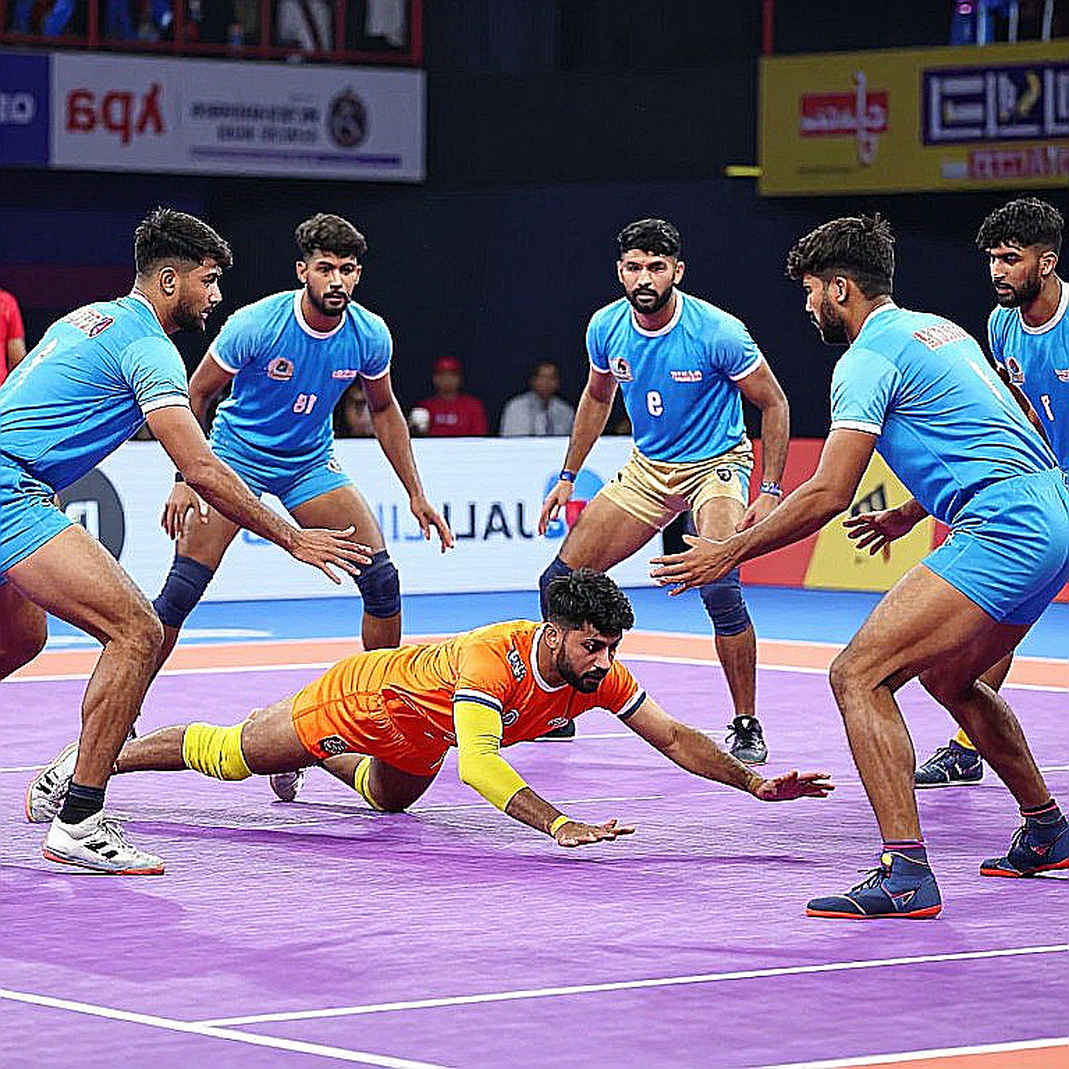
One thing has to be understood here, and it is built into the shape of the sport. The court is 13 by 10 metres, seven players a side, two twenty-minute halves, attack and defence alternating. The raider has thirty seconds to cross into the opponent's half, touch someone, and return, and must chant "kabaddi-kabaddi" continuously for the entire raid. That chant is not atmosphere — it is proof that the raider is not inhaling. If the chant breaks, the raid is void. This is the only sport played under forced breath control. When I write that line I remember the nights I sat in the north stand of the Jawaharlal Nehru Indoor Stadium in Chennai watching Tamil Thalaivas, and you could hear a raider's breath break before you heard the crowd scream.
One more rule matters directly to captaincy — the bonus line. A line marked deep in the opponent's half, worth one point on crossing, but only when the defending side has six or more players on court. The rule rewards raiders who attack a full-strength defence. Now look at what the release says about Naveen Kumar — that his individual raids shift momentum. That connects to this rule. If Naveen is deployed as a deep or bonus-line raider, his value is not just touch points. His value is that he forces the opposing defence to spread, and in that spread tackle angles open for the next raid. That is the mechanism the release flattens into "individual raids shift momentum."
Now the part where I have to disagree with the people praising this release. A defender-captain paired with a raider-vice-captain is not an innovation. It is kabaddi's most standard discipline-plus-firepower split. The corner defender sees the whole mat, counts the do-or-die clock, and manages defensive rotations — which is why defensive captains are common in kabaddi, because defence is the unit that needs constant coordination. Selling this as strategic thinking insults the reader who knows the sport. The right question is not whether the pairing is good. The right question is who sat behind this pairing, and on what basis they chose it, when the release does not even name a selection committee.
There is something else that bothers me. The release says the captain will be "responsible for organising the team in high-pressure situations." That is a tactically correct statement — but only if the tournament's rulebook gives the captain those levers. If this event is played in circle style, the whole picture changes. Circle style — circular field, one-on-one attack and defence, the rural Punjab tradition — scores differently and rewards a completely different athlete profile. And that worry is not absurd. A tournament drawing teams from Pakistan and the UK and Canada diaspora raises a real possibility of circle-style participants or a hybrid rule set. The release does not say anywhere which rules apply. That small omission shakes the foundation of any analysis.
In 2026 I watched India lose the Jakarta Asian Games semifinal 18-27 to Iran. The first gold lost after seven straight. Days earlier, a 23-24 group defeat to South Korea. The women took silver, losing the final 24-27. I wrote 1,400 words arguing that reputation-based selection had collided with wrestling-built defence. My campus editor cut it to 500 and moved the score to the first line. He was right, and that was the annoying part. Since that day I put the number before the argument in every kabaddi report — score, raid-point differential, tackle count. And I stopped calling Iran a spoiler. Since that week they are co-favourites in every preview I write. That is the discipline I want to apply to this announcement.
Because there is not a single performance number in it. How many tackles did Surjeet Singh complete last season? What is his success rate? What is Naveen Kumar's raid strike rate? What is his conversion in do-or-die raids? Not one of those numbers has been provided. Naming a player captain and offering not one figure in his favour is not journalism — it is a formal ritual of information. I am not saying the decision is wrong. I am saying it is not verifiable, and what is not verifiable should not be treated as praiseworthy either.
There is a broader context too. Captaincy matters more in the Pro Kabaddi League because rotational substitutions, technical timeouts and TV reviews are tools the captain and coach run together. But whether this new event adopts the same substitution and review rules is not stated. If it does not, the captain will not have the levers for which he is being called the man who organises under pressure. The release is praising a post whose powers it never defined.
Let me add a layer nobody else seems to have noticed. This announcement does not talk about a single player — only two posts. Captain and vice-captain. Who are the other fifteen or sixteen? Which state are they from? Which franchise or services team? Not a mention. This is the thing that grates most in kabaddi coverage. When a team's captain is announced and the rest of the team stays invisible, the reader never learns who is in the team, and therefore cannot judge the captaincy call in context. My spreadsheet holds nineteen lockdown interviews — a left corner defender who went back to his family's two-acre farm in Sonipat, a Railways-employed raider on unpaid leave, a women's state coach whose entire camp dissolved, a franchise analyst furloughed in Bengaluru. Nobody was paying for kabaddi copy that summer. I logged them all in one sheet — phone numbers, villages, contract status, and what each of them actually needed. That sheet is still updated monthly, and it tells me where the real story is when a team is announced — not in the captain's name, but in the people left off the list.
Last year I spent eleven hours in the Season 12 auction — twelve franchises, more than five hundred names, twenty-second bids — one of three women among roughly forty reporters. Then I moved into a Hyderabad hotel for seventy days. The same two team analysts at breakfast, and Dabang Delhi's title run I watched from the press tribune and from the team bus. I learned more about raiding departments from a 6 a.m. corridor conversation than from any press conference. Since then I write the auction as the story of the four hundred unsold names, not the ones getting rich. And when a coach says "we're fine," I quote the analyst instead.
That is the standard I apply here. Surjeet Singh and Naveen Kumar — this pairing can work. Giving defensive command to an experienced corner defender and attacking responsibility to an explosive raider is logical. But "logical" and "proven" are different things, and this release does not supply the evidence to reach the second. What stings most is the release turning into self-promotion — follow us on Facebook, X, Instagram, download the app, join WhatsApp and Telegram. An announcement from a sports body that contains no team list but does contain an app download prompt has told you its priorities.
What should we watch next? Three things. First, the organisers must clarify which body sanctions this championship and which rulebook governs it — standard style or circle style. Second, the full squad announcement with the head coach's name, and who made the selection. Third, and most important, Surjeet's and Naveen's numbers from last season, so the captaincy call can be tested against data rather than the adjectives of a press release. Until those three things appear, this announcement is not news. It is an intention. And in kabaddi, as I learned from my fourteen-issue fanzine, last place still keeps score — but only when the numbers are on the table, not just the names.
संबंधित खिलाड़ी
अनुशंसित
Kabaddi's Second Life: From the Clay Pit to the Broadcast Screen2026-11-02
The Bottom-of-the-Table Ledger: Kabaddi's Real Economy Shows Where Nobody Opens the Books2026-11-04
A Wiped Mat, 13 Nations and One Struck-Out Name: The Unfinished Ledger of Pakistan's Withdrawal2026-10-29
11 Raid Points, Still Lost: Kabaddi's Scoreboard Isn't Lying, It's Just Incomplete2026-11-01
अनुशंसित
Empty Scorebook, Unfinished Report: In Kabaddi, No Story Survives Without Evidence2026-10-28
The Drum Stopped: What Pakistan's Last-Minute Withdrawal Took Away From the Commonwealth Kabaddi Championship2026-10-22
No Source Data Available for In-Depth Kabaddi Reporting: Stage-1 Failure Prevents Analysis2026-11-10
Surjeet Singh Captain, Naveen Kumar Deputy: The Commonwealth Kabaddi Championship Announcement and the Silence After It2026-11-12
Kabaddi Analysis Report: Why an Empty Stage-1 Output Cannot Support an Original Article2026-11-10
अनुशंसित
Kabaddi Champions League Expands to 10 Teams With Rs 5 Crore Purse, But PKL's Broadcast Crisis Is the Real Story2026-11-03
Ahmedabad Soil, Commonwealth Face: Kabaddi's First Championship and Its Unspoken Gaps2026-10-22
Commonwealth Kabaddi Championship 2026: Day 1 Points Table Tells Only Half the Story as Score Difference Rewrites the Script2026-11-03
A Rs 5 Crore Purse, a Rs 17.4 Lakh Top Bid and PKL's Empty Studio: The Real Kabaddi Question in Haryana Is Where the Camera Didn't Go2026-11-03
India vs England, Commonwealth Kabaddi Championship 2026: A Test of Young Talent, Squad Rotation and the Real Stakes2026-11-12
अनुशंसित
The Drum Stopped: What Pakistan's Last-Minute Withdrawal Took Away From the Commonwealth Kabaddi Championship2026-10-22
From 14 to 13: Pakistan's Name Is Struck Off in Ahmedabad, and the Number That Matters Went Uncounted2026-10-29
The Bottom-of-the-Table Ledger: Kabaddi's Real Economy Shows Where Nobody Opens the Books2026-11-04
The Global Rise of Kabaddi: From Clay Courts to Professional Leagues2026-11-01
The Injury Map of Kabaddi: 214 Events, One 40-Second Window, and the League's Unfinished Ledger2026-11-01